Murdoc Is God
"Murdoc's metal band would have been in the movie "Celebrity Harvest", had it been made. (One of the many ideas) was that Murdoc would leave Gorillaz and form a metal band."
- Jamie Hewlett
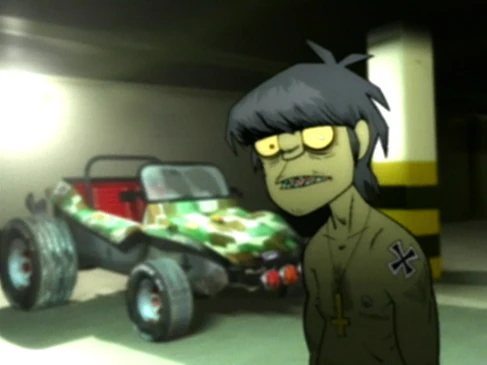
"Murdoc Is God", the second b-side to the "Dirty Harry" single, is a track written about (and most likely by) the band's bassist Murdoc Niccals. Murdoc was created to be a parody of the typical narcissistic rock star, with the tongue of Gene Simmons, the eyes of David Bowie, the overall look and language of Keith Richards and a crude mix of a bunch of other rockin' personalities to top it off. He takes himself way too seriously and believes in not only the cult religion of Satanism but the ideal of the "sex, drugs and rock n roll" lifestyle. The blog hasn't talked much about him (other than the fact that he's perhaps the leading cause of 2D's trauma and scars, physically and mentally), but in a way Murdoc represents the brains of the outfit being the one who formed the band in the band's ever expanding lore. Often times when the character isn't going on a rant for the purpose of shits and giggles, Murdoc's sentiments echo what Damon Albarn has said about the band in his own interviews.
Of all the songs I've looked at by the cartoon foursome, I had the least amount of ideas about what this song was about. The song's instrumental is done in what may be Damon's first venture into the genre of thick, hard and gothic heavy metal (with a hint of swaggering glam rock and noisy punk rock for good measure). The beat is centered around a repetitive rocking beat set by James Dring which is quickly followed by the noisy combo of distorted basses and electric guitars played by Damon Albarn (guitar) and Jason Cox (bass). The guitar sound on this track is like something I've never heard before, decked out in weird phasing almost "wah-wah" type effects while still retaining a raw and even somewhat frightening sound. And the vocals, the vocals are just a repeated chant of "Murdoc is god. Murdoc is god. Murdoc is god. Murdoc is god. Johnny is dead." This song sounds like nothing Gorillaz have done before or since, in fact, that doesn't even sound like Damon Albarn singing. And that's when it hit me...
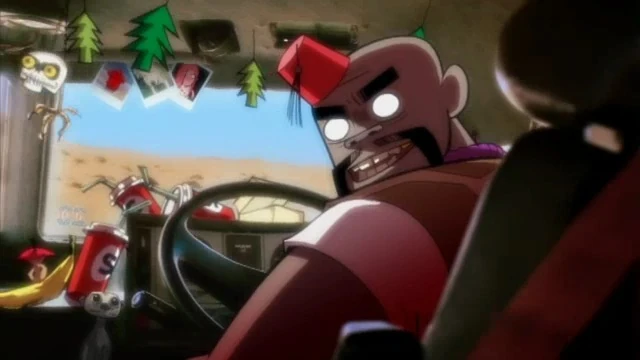
In the original idea for the Gorillaz movie, "Celebrity Harvest". Murdoc was going to form a new metal band after Gorillaz break up and he would eventually ditch them at Kong Studios, where they would be attacked by zombies, thus becoming zombies themselves. Damon Albarn was going to write new songs for the movie and was writing some while on tour with Blur in 2003 ("Dirty Harry" was written on this tour). When Damon came back and found out that the movie idea was scrapped, he and Jamie planned to use the songs and imagery from the movie on what was originally planned to be the band's second record, "Reject False Icons". So my theory is that this wasn't originally meant to be a Gorillaz song, this was meant to be a song Murdoc's new band played in the movie that Damon Albarn (probably excited to dip into an area of music he hadn't tried before) decided to record anyway. This would explain why Damon Albarn isn't singing in his 2D voice or even his own voice, because he is singing in the voice of one of the characters (pictured above) from Murdoc's metal band. But that leaves one more question, who is "Johnny"? That I can't tell you, but maybe he was a character from the movie we never got. The lyrics don't really matter in the long run because Murdoc wrote them about he awesome he is, you can replace Johnny's name with any other name during that section and the song will still work just the same. The song ends in a cacophony of noise, every instrument shows no restraint as if the band is coming out of your speakers to tear you in half. In the background there is a demonic choir backed up by a low mixed organ as if representing fear from those around them. The song ends in feedback and noise, there were no survivors.
"Murdoc Is God" remains a weird oddity in the Gorillaz discography and was probably never considered majorly for placement on "Reject False Icons", yet alone "Demon Days". Regardless of what the track may mean, "Murdoc Is God" remains to be an awesome track that sounds like nothing Damon Albarn has ever tried on a record.
Translate
Sunday, August 27, 2017
Friday, August 25, 2017
Hongkongaton
Hongkongaton
"What's all this rubbish?"
- Jamie Hewlett, screaming at his TV circa 1997
"Hongkongaton", one of two b-sides to the "Dirty Harry" single, was a track recorded very early on during the "Reject False Icons" stages of recording (see "RockIt" entry for more details). Like many of the songs from these sessions, the song can be seen as a link between Phase 1 and Phase 2 with it's lyrical direction, organic instrumentation and dub reggae influences. The song is also only one of two Gorillaz songs to feature co-creator Jamie Hewlett on it, with his role being the guy who shoots the toy laser gun throughout the song.
The song starts with the sound of rather disturbing sounding slurping which soon transitions into Damon's showtuney ragtime piano part making the song sound like a villain's theme from some off-putting musical. In the background there are some handclaps and synthesizers which pop up to offer countermelodies. During this section, Damon offers the song's only verse which is repeated twice, "Just falling out, not making much of anything at all. But all you could hide from what's there in the past of it". Damon sings this verse through demonic distortion effects and is making a commentary on the average pop artist and their fanbase. There comes a time where every pop star starts making even worse music than they did before, "falling out" and "not making much of anything at all". Most people will jump ship at this point but their most loyal fans will stay true to them, "hiding" from their new music and only listening to their old classics, "the past of it". As the song progresses, Jason Cox's awesome bass part drops in and out along with James Dring's cool but calm drum work and a xylophone played by Damon. The rest of the song involves an army of 2D voices chanting parts of the verse in a soothing and melodic fashion like the evil hypnotizing snake from "The Jungle Book". He's mocking these pop stars and their fan base by not only singing the rest of the song in this fashion, but by being a man who once was in a world conquering pop group and yet refuses to slow down and make middle of the road garbage. He's still pushing boundaries, and nothing's gonna stop him. "HONGKONGATON" he shouts throughout the song as if it's a war cry. Gorillaz will continue to take down manufactured pop music and all those who defend it, whether it's with Damon's cutting lyricism or Jamie Hewlett's snarky drawings (or maybe he'll juts shoot you with his toy laser gun...)
"Hongkongaton" is in many ways the exact opposite of another Gorillaz song which shares half it's letters, "Hong Kong". While "Hong Kong" is a very complex symphonic track that features Damon Albarn singing a soft plea without being under the guise of any character, "Hongkongaton" is a minimal synthetic "no wave" piece which features Damon Albarn taunting and jabbing at his contemporaries all while being completely in character under the mask of 2D. "Hongkongaton" is in many ways Gorillaz anthem and theme statement as it is about what Damon and Jamie's original intentions were, to put a stop to commercial music without meaning. "Hongkongaton" would be one of the last times the duo directly attacked the industry in their songs and the results yield a brilliant and thrilling piece to listen to.
Thursday, August 24, 2017
Hong Kong
Hong Kong
Hong Kong (Demon Days Live)
Hong Kong (Escape To Plastic Beach Tour)
"This is a song about your city"
- Damon Albarn to an audience at Hong Kong Asia World Arena, 2010
"Hong Kong" is a beautiful song with a message that someone like Damon Albarn would write. And by Damon Albarn, I mean the man himself and not his cartoon alter ego. Yes, this song became big when after hiding his face for so many years, he finally came out of the silhouette and into the spotlight to deliver this heartfelt song. He finally caved in and the illusion of "Gorillaz" was never the same again (but that's a topic for another entry). On "Hong Kong", we have a soft artistic symphonic piece that could easily have fit on one of Damon's solo records or even his latter day Blur record, "The Magic Whip" (an album which was made in and about the city of Hong Kong).
The song's original release was on a 2004 War Child compilation, "Help! A Day In The Life" and an official version would be released by the band on their compilation, "D-Sides". The only difference between the version is that Damon added strings into the official version to give the track a more cinematic feel. War Child being an organization which uses musicians to help charitable causes is probably what influenced Damon to write about the heartbroken city of Hong Kong. The groove is a simple mellow romp by Damon's acoustic guitar and piano backed up by Jason Cox on a light bass guitar and James Dring on subtle percussion. The main focus on this song however, is Zheng Zheng on the elegant guzheng zither, a Chinese harp. Her playing provokes so much emotion that a good half of this 7 minute epic is just her playing simple melodies to fill the gaps between Damon's verses.
Damon's vocals start with a plea to god (of course), "Lord, hear me now". But he's also asking for the attention of any of those around in a classic show tune type manner (Damon being the theatrical he is), "junk boats and English boys". The "junk boats" also refer to World War 2 imagery, back when Britain once owned Hong Kong, whose impact is still felt on Hong Kong with the "crashing" presence "super marts" all over. And to complete the WWII imagery he brings up, "electric fences and guns". He "swallows" his message, comparing Hong Kong to a "pill" on China's "tongue", referring to the fact that the communist country controls the fair city. But while he condemns the gentrification brought into the city he also admits that "the neon lights" make him "calm".
We are now in Damon's idyllic dream, stars "begin to explode" and "all the people" in his "dream" wait for the "machine to pick the shit up" and "leave it clean". He dreams of a Hong Kong where the people are no longer in fear of their communist monarchs from China. Zheng Zheng's playing further enhances Damon's dream like state but soon he wakes up. After he has woken up, Damon calls a child to come talk to him ("Kid, hang over here") and asks him "what he's learning in school", referring to how China takes out certain things in their textbooks to paint their country in the best light possible. He then blatantly questions if China ruling Hong Kong is a good idea, "is the rise of an Eastern sun gonna be alright for everyone?" Tackling censorship again he notices that "the radio station disappears, music turning to thin air. The DJ was the last to live, she had well conditioned hair. It was beautiful but nothing really was there". "The DJ" as in many rebellious songs, is an object of the government, only playing the soft meaningless crap that they deem "safe" to hear. Damon paint the DJ as beautiful and shiny, but he sees under the surface seeing how despite it's attractive packaging, there is no substance to be found. While this can compare to the way Gorillaz have always rebelled against pop music, it more accurately portrays the shiny city of Hong Kong. It looks nice, but something's amiss underneath the surface. The song ends with Zheng Zheng's zither and Damon Albarn's piano duetting. In the last couple seconds everything drops out but Damon's piano, a melancholic ending for a melancholic song.
"Hong Kong" got it's reputation as a fan favorite from it's dazzling performances as an encore at the "Demon Days Live" showcases. Everyone is on point here and Zheng Zheng is an amazing force to watch play. The song was brought back to the stage at Gorillaz first show in Hong Kong in 2010 where the band reunited with Zheng Zheng to play a somewhat shortened, but still meaningful, version. I'm sure Gorillaz will play the song again, as it seems to be a favorite of Damon's who often plays it live in some of his acoustic sets to this day. "Hong Kong" adds another depth of commentary to the Gorillaz library and it's performances gave us the first peek behind the scenes at the men pulling the strings of the operation (for better or for worse).
Tuesday, August 22, 2017
Highway (Under Construction)
"You And Me"
"Highway (Under Construction)", one of two b-sides to the "DARE" single, is among one of the most underrated things Damon Albarn has ever put out. The song is a personal song about Damon written in his own voice and features him getting back in touch with his roots.
The instrumental starts out just a live take of James Dring doing handclaps, foot-stomps and additional percussion, Jason Cox keeping a steady bass line and Damon singing with a clean electric guitar. The basic structure of the instrumental is very old school, done in the style of old 1920's blues, country and even earlier slave spirituals. As the song goes Damon quietly counts in "doo wop" esque backing vocals and many different kinds of keyboards. The keyboards used go through all of his many stages as an artist: experimental and noisy Brian Eno type synthesizers, his signature Britpop organ sound done with a touch of psychedelica and soul, and the song ends with a piano solo done in a classical vaudeville fashion.
Damon's first lyric states his intention: "well, I'm building a highway back, back to the heart of things. No love left to walk back, back to the heart of things". He's looking back on his life in this track, comparing his nostalgia trip to that of building a highway to keep in touch with this song's melodic roots in that of old slave spirituals. He thinks back to his days as a kid, being an outsider in his school, realizing there is "no love" he found from the people he grew up with Essex and Leytonstone. He then says, "I'm walking above and back, all our city gone wrecked. When I get it all for you, I'm gonna get it all true". He's walking through his town and remembers the wreckage it was all in before it became the gentrified suburbs it was in his teenage years. He refers directly to "you", the listener, saying he's not gonna hold back anything "for you", it's "all" gonna be "true", no detail left behind.
Following this first verse, is a classic organ solo which goes from classic Blur style to something more spacey and experimental (accompanied by synthesizers at this point, of course). Then he throws a curveball, he's not gonna let you get to close to his life, as this is a Gorillaz song after all. "It's cold in a state gone by. People holding a meaning, why?" He's saying maybe this isn't true at all, maybe it's a cold "lie", and follows this line by saying mumbled nonsense about "swimming" and "boats" ("winds and "sails" as well). He then ends the song by saying "Cause I'm old, I will say goodbye, hoping to run out on one lie. If I get a lot from you, I'll make it all come true". He think he's getting too old for the "pop music" game, and this Gorillaz album would be the last time anything he did that stayed on the "charts" for a good decade or so, making it his "goodbye" in a way. He hopes to run out on the "lie", as if saying his writing isn't who he truly he is, throwing yet another curveball to the listener. However, if he thinks your interested or "gets a lot from you", he'll "make it all come true" and come back to play tunes for the masses again. The song then becomes centered around a jaunty piano solo which gets fade out in a cloud of reverb, as if the listener is walking away. The listener is uninterested in this old British man's ramblings, leaving our guy to bang out a tune on the piano with his mates, alone and un-interfered, like he always wanted.
"Highway (Under Construction)" is in a way, Damon's goodbye, and probably wouldn't have even made it on to "Reject False Icons", even if that's what came out. Because "Highway" is not a Gorillaz song, it's Damon's song. It has his voice written all over it, sure he might be trying to do the 2D voice, but the song is too evidently Damon to pass as a Gorillaz song. This could have showed on a Blur record like "The Magic Whip" and no one would have batted an eye (and there's a strong argument that Damon is more personal in Gorillaz than Blur but "that's a whole 'nother discussion we can't fit in these kicks"). "Highway (Under Construction)" is Damon's story, it's a showcase of his method of songwriting and his usual tricks and it's one of the best things he's ever put on tape.
68 State
68 State
"Demon Detour"
"68 State", the final b-side to "Feel Good Inc.", is an instrumental track which stays in line with one of Gorillaz many traditions in each phase. The track was most likely recorded in the early "Reject False Icons" stages of the project as it seems to fill the gap of the "instrumental track" Damon had on almost every album he made up to "Demon Days".
"68 State" mainly consists of three sections: a build-up intro which features a drum machine loop and synthesizers that sound like wind passing by (all of the above done by Damon). As the intro goes on, Jason Cox's steady bass guitar comes in and Damon warms up his "wah-wah" soaked electric guitar; the second part which features the guitar duetting a new melody with Damon's organ (a staple to all of his instrumental jams) and the third part which acts as the "chorus" to the second part's "pre-chorus" which features the guitar become triumphant, offering a fierce melody accompanied by synthesizers, with the synthesizers eventually taking over. The second and third parts make up the majority of this song through their many repeats.
A lot of Gorillaz songs are about cars or traveling of some kind. Songs like "19/2000" or "Stylo" have videos of the characters driving around and "M1 A1" is named after a British highway and details the band taking the road on a journey. This song continues that tradition, and is about the band driving down a highway, presumably one called "68 State". In the background, you can hear many synthesizer effects that sound like siren, wind and other car engines. These give you the feeling of being on a road trip with the band, if the song was given a visual, I'm sure it would have been the band riding around in a tour bus maybe in like the desert or something. In a way, this song is an ancestor to the experimental instrumentals (albeit using more organic instrumentation) on the band's record, "The Fall", which details Damon's thoughts while on the band's 2010 tour in America.
"68 State" was probably cut because with the album developing more of a concept storyline about American politics and religion, a track like this no longer fit on the record (maybe it could have been an interlude placed in the middle, but even then the track would have seemed like an unneeded detour from the actual record). "68 State" is a great track which works nicely along side the other Phase 2 Gorillaz tracks while retaining the spirit of Gorillaz sound, despite the lack of any vocals from Damon himself.
Monday, August 21, 2017
Bill Murray
Bill Murray
"As for Gorillaz (next record), Albarn revealed that he is planning to use The Bees as the house band for the new set of songs..."
- 2004 NME article called "Damon's Dash"
Ok, before I begin this article I would you all to watch this clip of Damon Albarn recording "Bill Murray" with The Bees here
Have you watched it? Good, because I am going to be referring back to it a lot in this article.
The Bees were once a big deal in the early 2000's indie rock scene with their genre splicing style and massively talented unit of many different musicians. Damon Albarn was among one of their huge fans, and at one point, considered having The Bees play the role of the Gorillaz band on their second album leaving Damon only to be the chief songwriter, vocalist and producer. This plan however fell through as The Bees were on a busy schedule of their own, but not wanting to pass up the offer of working with one of their heroes, they came in to record one track. This track was "Bill Murray", a name which Jamie Hewlett gave the track after listening to it once in an off hand manner with "no relation" to the actual track itself.
The track was obviously recorded in the very early stages of recording, back when the album was called "Reject False Icons" as sonically it's more of an extension on the first album's sound and not that of the new sound Damon would develop during recording. The Bees' influence can be prominently felt on this track with the song's funk fused, ska infected and Specials influenced groove. However if you see how the band originally recorded it, the track we ended up getting was much different than what was originally done in 13 Studios.
The track was birthed out of a jam between Damon and The Bees. The Bees, being huge fans of the first album, were unsure how to re-create the band's strange and off putting experimental sound. However, Damon Albarn told them he wasn't looking for "weird", and suggested the band vamp on the chords A and F#min. Damon played orchestrator to The Bees telling instruments when to play and when not to play and in post-production he would remove instruments at will, making the original jam's prominent guitar and synth solo no more than mere cameos. The stars of the final product we got was the main synthesizer melodies, the brass section and the tight groove provided by the bass guitar and drums. While it may seem like Damon was forcing The Bees to play under his strict guidelines, what Damon did with the jam session is brilliant and reminds me of the way Brian Eno recorded artsy and punky (yet funky) band, Talking Heads on their magnum opus, "Remain In Light". Before the vocals finally kick in, the bass guitar gets a spotlight while the brass respond to th spaces left underneath the bass groove (as per Damon's instructions).
While the vocals were originally supposed to be a harmony between the members of The Bees and Damon as 2D, Damon ended up only utilizing an army of his own voices to get a psychedelic Beach Boys type effect on the vocal (see "Demon Days" entry for more details about this method). His repeated vocal state, "Too many days to get lost. Many many people I've known, got lost". His lyric is about those who he has once known, the people who he used to be close with who he no longer talks to, the people who have "gotten lost" in his mind. If he was talking about anyone directly, I would guess it was Blur guitarist Graham Coxon, whose relationship with Damon ended very messily causing Damon to avoid anything to do with Blur for slightly more than half a decade. However, the lyrics are vague enough to be about anybody, so it could just be Damon being 2D, the sad depressed, messed up kid who fronts the band against his will. After the first time he says this chant, the brass play mournful line as if signifying the loss of a former loved one, but then the groove comes back and the song becomes a fun skanky jaunt again with 2D now singing his line over the groove. A fun song, with a bittersweet message.
"Bill Murray" most likely never made it on to the final record because it was recorded before the album fully formed into the social commentary art piece we have now, meaning that it no longer fit in context with the album's thematic ideas. Despite this, "Bill Murray" seems to be a favorite of Damon and Jamie's, making it a b-side to "Feel Good Inc.", the band's biggest single, as well as including the footage of them making the track with The Bees in their documentary, "Bananaz". "Bill Murray" is an awesome track in all of its instrumental complexity and vocal simplicity.
Sunday, August 20, 2017
Spitting Out The Demons
Spitting Out The Demons (Damon Albarn live with backing band The Heavy Seas, 2014)
"Sex and drugs rust myself, it feels holy, it feels holy."
- Damon Albarn, "O Green World"
"Spitting Out The Demons", one of three b-sides to Gorillaz smash single, "Feel Good Inc.", is a brilliant tune which fits right in with the themes explored on the "Demon Days" album. It starts with a piano, dutifully played, leading us on, building to something, and it certainly does. The bass and drums enter laying down a smooth and funky groove with traces of laid-back ska that a band like the Red Hot Chili Peppers exemplify. You can hear echoes of the piano that once was in the background, but the forefront of this song is the groove played by Jason Cox's distorted bass guitar and James Dring's smooth drumming. The song's loose feel gives me the feeling that the song was improvised live in the studio with Damon joining them on a guitar (played upstroke of course) and then adding synthesizers and echoes later on in production. The instrumental lead-in takes up almost half of the song, but soon enough an army of Damon vocals kick in.
The way Damon delivers his chant makes it seem as if it was improvised on the spot as well, due to it's repetitive nature and the free flowing mumble and random ad libs found all around this track. However, I think the lyrics were written beforehand as the chant in question relates to the storyline used on "Demon Days". The words Damon says are, "spitting out the demons, popping out of holes. spitting out the demons, popping into good times. spitting out the demons, falling out of airplanes. spitting out the demons, the devil he won't help me." I think Damon as 2D seems to be trying to become "good" again. Throughout the record, 2D tries to talk to god in the dark times the world was in. He wanted answers, but he also wanted to change who he was. He wanted to change his "sex and drugs and rock n roll" lifestyle and become someone who was "pure" and "holy" in god's eyes. He was "spitting out" his "demons", relinquishing the things that once controlled him in the sinful life he lead. He repeats the one line, "the devil he won't help me" at the end as if he's telling himself that all the things he once loved like drugs and sex, were products of the devil and not worth doing anymore. In other words, this track is 2D's late and informal baptism. However, as we all know, this change of heart for 2D didn't last long.
This song probably didn't make the final cut due to it's long intro, Damon's vocals don't come in until about three minutes into the five minute cut, and then his lyrics aren't anything more then a simple chant said over and over again. This song is unique however in that it is not only one of a few b-sides to ever be played live, but it was played live for the first time by Damon Albarn during his 2014 "Everyday Robots Tour" and not by the Gorillaz themselves. Damon Albarn's band for the tour, The Heavy Seas, make the groove tighter, speeding up the instrumental so that Damon's vocal line comes in faster and making the bass and drum beat even more prominent and boisterous then it was before. Damon's vocals are chanted along with them by he choir of backing vocalists, giving the idea that the choir is egging on 2D's rebirth as a good Christian in classic gospel fashion. This song kicks ass live and was apparently sound checked on the band's long marathon of shows known as the "Humanz Tour", but as of now has yet to be played (I'm sure the band will play it soon enough though). "Spitting Out The Demons" expands upon the themes of religion played throughout the "Demon Days" album and is a great addition to the Gorillaz canon which we all rock out to for years to come.
Subscribe to:
Posts (Atom)