Translate

Monday, June 19, 2017

Hip Albatross

Hip Albatross

"I mean look at (2D)... he looks like a trapped boy. I don't know maybe he's just a great actor, fucking doubt it though."
- Murdoc Niccals


"Hip Albatross", the second b-side to "19/2000", is a beautiful rock ballad done in a very unconventional way. The track's instrumental mainly consists of samples of zombie films such as "Dawn Of The Dead", the track's instrumentation and even the vocals on some occasions, take a back seat to the various sounds and dialogue used throughout the song. It opens with a quote, one used often during Gorillaz early days: "Every dead body that is not exterminated, becomes one of them. It gets up and kills. The people it kills get up and kill."


It's possible that the song resulted from a live take with Damon on vocals and electric guitar, Junior Dan on bass guitar and Jason Cox on percussion and then the samples were added on later (along with some spacey keyboards played by Damon). Jamie Hewlett pushed for there to be more songs about zombies on the album as it was a huge part of the storyline he created. So Damon made this song (along with album closer "M1 A1") to fill that gap.


Damon has one sentence which he repeats once before the song dissolves unto itself: "I was born a zombie, from mercury, I just sleep." He stretches this one sentence out into what essentially becomes two short verses. Damon sounds like he's in pain and anguish, the way he stretches out the "I" makes it sound like he's a zombie. But maybe, that's what he was going for. In truth, this may be one of Damon's best tries at getting into the character of 2D. 2D is scared and drug addled, his mind is a mess. His love of zombie films might be affecting him to the point where his mind is always playing clips of zombie films every waking moment, thus making him more scared and afraid. He relates to the zombies, tired and mindless, afraid and confused. Soon the song fades, another sample comes out to play while a mournful electric guitar plays a tune. The sample says: "Yeah yeah, I got an alternative! Let's get in that old whirlybird here, find us an island someplace, get in there, and spend what time we got left soaking up some sunshine." There's still hope for him to be happy and at peace, it just has to be away from Kong Studios, away from Murdoc, away from it all. Until then though, he's stuck here.


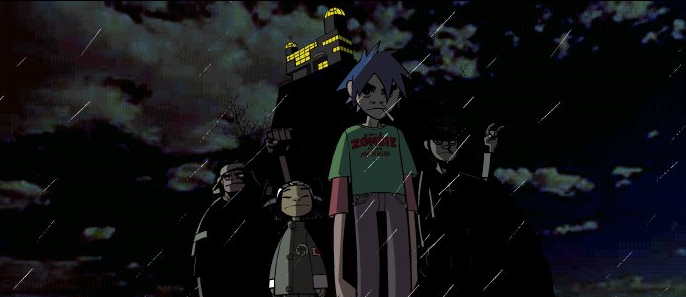
The track was used to open the band's documentary, "Bananaz", where it was paired with images of a graveyard that Damon and Jamie rode past in their car. These dark yet realistic images perfectly summed up the feelings conveyed in this song, making one wonder if they ever considered bringing this track to the stage. "Hip Albatross" wouldn't have fit in among the more energetic sets from the band's first tour, but it would have been right at home among the dark atmosphere of the "Demon Days" shows. It's possible that the track didn't make it on to the album because it was too predictable. If you take out all the samples, it sounds like a song Damon Albarn would have made with his old band Blur, (particularly the moving "1992" off of their magnum opus, "13").  Hip Albatross" is one of the most moving songs the band ever made, giving us a look into the inner monologue of our blue-haired boy which digs deep.


Friday, June 16, 2017

Left Hand Suzuki Method

Left Hand Suzuki Method (Full Version)
Left Hand Suzuki Method (Music Video Version)

"Art expresses man"
- Shinichi Suzuki


Of all the singles from Gorillaz debut album, "19/2000" contains the strangest b-sides. One of the two b-sides is "'Left Hand Suzuki Method". Originally titled "Exhumation", this track is one of the strangest and most "avant-garde" tracks in the Gorillaz library, experimenting with trip hop, no wave, dub, classical music and foreign language spoken word poetry. The song is also the first song where the character of Noodle (Miho Hatori) takes complete control over the vocals.


On your first listen, it's hard to exactly pin point what the track is going for. It starts with the sound of someone lighting and smoking a bong followed by eerie synths. Kid Koala plays one of his classic manipulated vocal samples ("feel the impact") and the song is off. The song is based off a drum sample of Muddy Waters' blues classic "Mannish Boy" which is doubled by drummer Jason Cox, this gives the song a breakbeat vibe similar to that of another Dan The Automator project, Handsome Boy Modeling School. The song is crowded by various sounds, Damon's electric guitar sneaks up on the downbeat and Junior Dan (nicknamed "Left Hand Dan", which is where part of this song's title comes from) provides a rhythmic basis with his bass guitar and various cartoon noises, ragtime pianos, synths and "orchestration" creep in and out of the track. The track even sometimes takes a moment to have a violin solo, courtesy of a sample of Thomas Haynes Bayly's "Long, Long Ago".  The track seems to have been done in classic DJ style, meaning all the instrumentation was looped and Dan The Automator and Kid Koala pulled all the loops in and out of the track at various times to make a complete instrumental beat. The only constant throughout the 5 minute epic is Miho Hatori's vocals.


Miho Hatori talks over the first 3 minutes of the track, only taking a couple brief breaks for the track's violin solos. She goes from Japanese to English seemingly at will, however there is a structure to it. Miho is talking about the teachings of accomplished musician Sinchi Suzuki. Sinchi Suzuki taught that anyone could play music through listening to music and figuring out parts by ear without learning music theory or being able to read sheet music. This method was called the "Suzuki Method".  Miho Hatori uses the song to sum up Suzuki's teachings, saying her lines in Japanese first then English. Not counting repeats, this is what she states throughout the song in little Noodle's broken English: "The most important is listening, the recording of the music. It makes them get, um, musical sense and, uh, that's the point of past progress. And also, everyday, every lesson, we have to make sure they learn about tonalization." After Noodle delivers her lecture, the song slowly builds from the drums and bass by themselves, to all of Damon's overdubs coming back. It's as if Dan The Automator is showing the listener how he built the track up, teaching through example.


"Left Hand Suzuki Method" was considered for inclusion on the band's first record, showing up on early unmastered mixes of the band's record. Being a track that was completely sung by another character in the band and not 2D probably played a lot in it's favor. However the track did not end up on the final version of the album, possibly because it was too strange and experimental along side the album's other tracks. The track eventually came out as a b side in a heavily edited 3 minute version which faded out before another violin solo, a repeat of Miho's vocals and Dan The Automator's outro. "Left Hand Suzuki Method" was eventually given a music video in 2006 called "Monk's Montage" which paired the song with various animations from the band's second album, "Demon Days". "Left Hand Suzuki Method" is one of the band's most daring tracks and is deserved of more recognition.


Thursday, June 15, 2017

Dub Dumb

Dub Dumb

"Democrazy"

The task of analyzing every Gorillaz song is a difficult one to do. This is mainly because Gorillaz have a lot of songs which don't end up on compilations, albums or as b-sides. Instead these songs end up on other forms of media like movies, video games, mixtape compilations or even radio shows by unknown DJ's. A lot of these Gorillaz songs also end up on the band's interactive website, which always gives the visitor a look into the cartoon's HQ. In 2001 up until about 2009, their HQ was the zombie ridden Kong Studios.


Due to these songs being hard to track down, a lot of people ignore them and only pay attention to the albums. However these songs are important to know as Damon Albarn certainly loves his demos & sketches of songs. Damon Albarn often records a ton of tracks for every album he makes and ends up using about a fourth of the material he recorded for the album itself. For any songs he doesn't use he ends up either releasing them in some unusual manner or using them in later songs. One song that can be found in Gorillaz recording studio in Kong Studios was a demo of a song called "Gor Beaten". "Gor Beaten" would later end up in a different form on a movie Damon was soundtracking called "101 Reykjavik", the song now being called "Bar Beaten". Damon treats his unfinished song sketches almost as well as he does his finished songs, so it's important to look at Gorillaz demos alongside their album works.


One of the first sketches to be unearthed from the band's debut recording sessions, was a charming little track called "Dub Dumb".  "Dub Dumb" was most likely recorded during the early days of the band's existence due to it's cliche use of monkey screams at the end. Early sketches done by Jamie show that the band played up the whole "Gorilla" thing more at first, even at one point going as far as having a "gorilla in the band that plays bongos."


This track was probably used as a guideline for the sound Damon wanted to achieve with two of the album's main players, bassist Junior Dan and drummer Jason Cox. The song starts with Cass laying down a simple beat as Damon hums over it. Damon's vocals are sparse and spread out throughout the song, never being a constant force. Junior Dan then comes in with a dubby bass line being delivered alongside some of Damon's synthesizers and some handclaps. Occasionally the track is interrupted by an army of synthesizers bringing chaos and disorder to the track (these synth sections sound as if they could have been an inspiration on Damon and Jamie's soon to be made project "Monkey: Journey To The West"). On top of these sections are a vocal sample which is scratched up and manipulated by Kid Koala in a similar manner to what he does on the band's song "Sound Check (Gravity)".  Soon after these new sections begin, the song's original groove comes back this time with added synths and an arpeggiated acoustic guitar which is put through a phaser by Dan The Automator.


After a couple rounds of these two sections battling for control, the two soon work together for a rapid fire rap verse by Jamaican dancehall artist Sweetie Irie. It's hard to tell exactly what he's saying but he delivers with a fantastic flow. Soon another interruption happens, a duet between a soft and mournful Damon piano and Junior Dan's bass lines. After this, there is a few seconds of silence making the listener think the track is over. However soon the beat kicks in again and we get yet another brilliant verse from Sweetie Irie. Soon the song fades out as the party sounds of "Dub Dumb" go off into the night and never stop.


"Dub Dumb" was likely never majorly considered for inclusion on the band's debut, so it was tucked away. Damon would end up asking Sweetie Irie to move his brilliant verse to the trashy dance mix of "Clint Eastwood" done by DJ Ed Case where it was subsequently slowed down and made less brilliant. However the song soon saw the light of the day when it was included on the Playstation 2 video game "MTV Music Generator 2". "MTV Music Generator" was a primitive game that allowed you to edit and remix songs that were included in the game's library. Gorillaz became a major selling point for the game (included on a sticker attached to the case!) as they not only contributed their biggest hit ("Clint Eastwood") to the game but a brand new, unreleased song! "Dub Dumb" is the sound of a band finding their sound and was an important step in the recording of the band's first album.


Monday, June 12, 2017

M1 A1


A1 M1 (Ruff Mix)
M1 A1
M1 A1 (Gorillaz Live Tour 2001)
M1 A1 (Humanz Live)

The following is an edited transcript from an interview with Gorillaz by Cass Browne from their biography "Rise Of The Ogre":

" 2D: Me and Russel got together one afternoon and I showed him loads of films that I'm into. All these knackered-out old zombie films. There's something that, like, resonates in me, really haunting, the same thing I get with music. This sense, of, like, being the only conscious soul. The difficulty in communicating makes you feel like you're trapped under ice. Searching, lost and... dislocated. Plus I like all the gory bit where they, like, eat each other's heads and stuff.

Russel:  I picked up on what (he) was trynna say, so I took this sample (from George A. Romero's zombie film "Day Of The Dead")... it just sets the scene. You're the lone soul searching for life.

2D: Lyrically I think I was trying to capture a sense of movement, speed and geography. "M1 A1", you know? To place Gorillaz metaphorically zooming down the great British motorway of life.

Murdoc: Empty motorways always alarm me and suggest... imminent zombie attack.

Noodle: I triple-tracked the guitars to make it sound like there was a bagful of cats being dragged behind the car. Then I screamed over the top."


Imagine the conversation between the cartoons in the quote above as a conversation between Damon Albarn and Jamie Hewlett and it's easy to see how "M1 A1" was birthed. "M1 A1" is the last track off of Gorillaz debut record and it ends the record with a bang. It's an experimental punk rock 3 minute blast that only a band like Gorillaz would make.


"M1 A1" started out as a jam with Damon on guitar and Dave Rowntree on drums. It was a simple two chord riff but it was powerful enough to build a slow and heavy instrumental off of. About a minute into the jam, bassist Junior Dan comes in adding a dubby bass riff on top of the noise (a common practice in experimental post-punk music used by bands like Public Image Ltd. and Magazine). Soon all the instruments drop out leaving Blur drummer Dave Rowntree alone on the live drums, the song then suddenly ends as most free style jams do. The evidence of this jam was recorded on what can assumed to be Damon Albarn's 4 track due to it's lo-fi quality, and was titled "A1 M1".


Jamie Hewlett wanted to make sure the album had all of the themes that he had come up with for the Gorillaz storyline, and one of the themes that wasn't present was zombies. Zombies as well as zombie movie culture would play a major role in the characters. 2D would be obsessed with George A. Romero movies, the band would live in a graveyard where band members could be possessed or mauled, and one of the ways the band described themselves in the early days was "Zombie Hip Hop." There were tracks recorded about zombies like "Hip Albatross" (which we will get to later) but a lot of these tracks would not make it on to the record. So Jamie suggested that Damon sample a clip from George A. Romero's movie "Day Of The Dead" on one of the album's tracks. As the two began to watch the movie looking for good lines to use, the movie began. The main characters are alone in a world, everyone else is dead or undead. They then go to search for life, going around with a megaphone asking, "HELLO?! IS ANYONE THERE?!" While this is going on, a minimal and sinister synthesizer instrumental is playing in the background.  As Damon was watching this, he then began to play his guitar along with the movie, and that's how they found their sample. Now they just had to find a track to tack it on to...


Damon decided to put it on top of "A1 M1", and gave the song to Dan The Automator who cleaned the demo up and smoothly transitioned the song's new intro into the song itself. Damon then added two more guitar overdubs as well as the album's only guitar solo, to give the track a noisy and dissonant type of chaos. The sample brought out the idea that it was about searching for life on a forgotten world. Damon wrote lyrics about this and the song became about 2D, Murdoc, Russel and Noodle searching for life across a British wasteland. Traveling on the M1 A1, a road that stretches across the entirety of Britain, at "a thousand miles per hour." They are screaming and chanting to see if anyone is there, Russel even bangs on a bass drum in an effort to get someone to respond. In the end, no one responds, so the band ends their efforts, leaving us with sustain from the multi-tudes of guitars on the track. They are the last living souls.


While "M1 A1" was the closing track on the band's first album, it was the opener on the band's first tour. The song was given a new context, it was no longer a cry for help but a hard rocker used to hype people up. ("HELLO?! IS ANYONE THERE?!" *crowd cheers*) It was probably one of the best songs in the Gorillaz Live band's repertoire. Simon Katz tears it up on the guitar, while Damon goes all out with the crowd from behind the screen, and of course, we can't forget about the amazing rhythm section of Junior Dan and Cass Browne. The song was never played live again, but many fans hope "M1 A1" (along with a multitude of other songs from the band's debut) come back to the band's ever changing live set. It finally came back on the Humanz Tour with Damon singing lead and strapping on an electric guitar, it became the opener proving that the band does listen to the fans after all. "M1 A1" is not only a fantastic and exhilarating album closer, but it is also one that foreshadows the dark direction Gorillaz would go in on their next album, "Demon Days".


Saturday, June 3, 2017

Slow Country

Slow Country
Slow Country (Gorillaz Live 2001)
Slow Country (Demon Detour)
Slow Country (Damon Albarn live with backing band The Heavy Seas, 2014)

""Ghost Town" is the sort of tune you can easily play in Detroit and it would easily send shivers down your spine. I like the shivers."
- Damon Albarn, on The Specials and music he fell in love with at age 13


The first Gorillaz album has two bands that cast a large shadow over the album's sound. These two groups are trip hop trio Massive Attack and ska band The Specials. The latter group's influence can be particularly heard on the album's penultimate track, "Slow Country".


Although The Specials are most well known for being a ska group that fused together the fashion of 1960's mod culture and the attitude of the 1970's punk rock scene, The Specials evolved their sound by the year 1980. With the release of the album "More Specials", the band took their previous fun skankin' tunes and combined them with new influences from another one of Damon's musical fascinations, dubby reggae. It is around this time that The Specials released their magnum opus, "Ghost Town". "Ghost Town" expressed the feelings of isolation and resentment in poorer English communities and did so through the use of dark dubby tactics instead of the usual fun party ska music in their repertoire.


"Ghost Town" became one of Damon Albarn's favorite songs and it was seemingly his goal to do some kind of reggae music ever since he formed a band. He would sometimes jam with Blur on reggae vamps in concert, however the band wanted nothing to do with it. So Blur became the outlet for Damon to experiment in anything under the "rock" category, whether it meant daring and experimental post-punk or plain ol' power pop. With Gorillaz, Damon saw the opportunity to due away with the whole ideas of genre altogether, and do whatever it was he felt like doing. With "Slow Country", Damon achieved this goal.


The beat of "Slow Country" is based around a sample of the beginning of kick drum and wind noises from The Specials' "Ghost Town". Damon decided to form a whole new song out of only about 4 seconds of build-up from another song. Jason Cox took this short sample and doubled it with his drum set and Junior Dan added one of his many signature dubby bass lines on top. Damon then added a piano riff as the main hook and a guitar playing two upstroke reggae chords (which is processed by Dan The Automator to such an extent that it sounds like a synthetic backing vocal).


With the addition of the piano and guitar, the song becomes more fun and uptempo compared to the usual Gorillaz dub. Damon takes a dub piece on isolation and turns it into an upbeat ska tune (combining an influence of classic Specials into a track which already contained influence of latter day Specials). Damon sings about living in the city and the struggles involved with it. People who are denied the ability to do what they love in order to "get money". However unlike many of the first album's songs, "Slow Country" offers a solution. Damon tells you not to sit and mope ("can't stand your loneliness"), and instead to focus on things you enjoy like the "night life". You may "get a lot of problems", but you can "kick a lot of them." Damon sells the song's good vibes with cheery synthesizer interruptions and a heart wrenching scat break done completely in falsetto.


When played live, the song takes on a more organic ska feel. The guitars are unprocessed, the bass and drums are raw, the keyboards are bouncy and Damon genuinely seems to have fun adding in spontaneous scat fills at will. Miracuously, Damon brought the song back on his "Everyday Robots" solo tour, extending the song's catchy and hypnotic groove out in order to hype up the crowd. "Slow Country" is not only a fan favorite and highlight of the band's first album, but it just might be one of Damon's greatest artistic feats. Here's hoping "Slow Country" will be brought back to Gorillaz live gigs once again.

Saturday, May 27, 2017

Starshine

Starshine (Demo)

"I feel so unnecessary"
- Damon Albarn, "Star Shaped"


If not for the band's brilliant b-side, "Dracula", "Starshine" would be Gorillaz most straight forward dive into the music of dubby reggae. The song's beat is anchored around a brilliant guitar line by Damon and a quiet drum machine provided by Dan The Automator. However the instrumental's star player is bassist Junior Dan delivering his greatest bass line on the record (The beats even stops for a moment after the first verse to give him a moment in the spotlight). In the background are atmospheric synthesizers and a dubby piano, all of which give the track a distant and chilled out groove.


Thankfully, the raps provided by Phi Life Cypher on the track's original demo were removed in production (although they were later re-hashed in a brilliant Gorillaz b-side "The Sounder"). The space that was once filled by gratuitious raps was now mostly empty, leaving more room for the listener to take in the song's brilliant instrumental (which any good dubby reggae should have). However, some of the now empty space was filled by an extra verse from Damon, which brings us to another star player on this track.


"Starshine" was most likely recorded in Jamaica due to it's dub feel. Damon Albarn, who at the time was struggling with heroin withdrawal and a recent break up, spent a lot of time outside staring ointo the Jamaican night sky (which is where he wrote and recorded the intro for Gorillaz track "Sound Check (Gravity)"). On "Starshine", Damon Albarn uses the night sky to write one of the most blatantly depressing and personal lyrics he has ever written. The song's main lyric is: "Starshine, never gonna find me? Starshine, they ain't gonna find me. Starshine, never gonna find me?  Starshine, never gonna find me." On "Starshine", Damon has his cartoon alter ego 2D staring into the night sky. He sees the darkness of the night sky and notices the light, or "shine", of the stars. The "starshine" is the only thing from keeping the outside world completely dark and wonders if he can ever grasp on to that light, seeing it as a way out of his own depression. 2D, being mentally challenged, soon realizes that the stars are far away and that the "starshine" is "never gonna find" him. 2D realizing there is no easy way out (no light at the end of the tunnel one could say) learns to "stand easy with (himself)" and find a way to be content. While the lyrics are written from the perspective of a depressed half-wit, the lyrics can easily be transferred to Damon's own feelings and personal struggles.


"Starshine" was a constant on the band's first couple of tours. The track was often extended up to 5 minutes, giving room for a melodica solo by Damon as well as some sonic and atmospheric sounds from the other members of the band's various touring groups. The visuals Jamie made to accompany it were cartoony graphics of stars and lights. These visuals contained no presence of the band's fictional members which meant that on the first tour, the audience caught a rare glimpse to see a silhouette of the man behind the music, giving Damon the spotlight on the album's most personal and "real" song.


Saturday, May 20, 2017

Latin Simone

Latin Simone (English Demo)
Latin Simone (Que Pasa Contigo)
Latin Simone (2D & Ibrahim Ferrer Duet)
Latin Simone (Live 2001)
Latin Simone (Demon Days Live Tour 2005)


"Latin Simone" is the first of many Gorillaz songs to lack a definitive version. It's original release as a b-side on the "Tomorrow Comes Today" EP was a Damon Albarn sung track with instrumentation that took influence from trip hop, reggae and of course, Cuban music. The album version expands on the track's Cuban direction by featuring Ibrahim Ferrer, of Cuba's very own Buena Vista Social Club, singing a new lead vocal in place of Damon's.


The track's instrumental features a Dan The Automator breakbeat layered on top of a drum sample from Keith Mansfield's "Incidental Backcloth No. 3." On top of this is a delicate piano line by Damon and a Junior Dan bass line which (as usual) fits perfectly with Dan and Damon's instrumentals. To compliment the track, Damon Albarn and Miho Hatori do choral type backing vocals bringing out the power in the words of the lead singer. Between the verses, Damon Albarn's melodica duets with Mike Smith's Bolero influenced trumpet. The two instruments feed off each other, giving the beat a bit more of a looser feel than the other trip hop tracks on this record.


 The original version featuring Damon's vocals takes more of a darker connotation. On most of the tracks on this record, Damon dances around the idea of 2D, the fictional band's singer, having issues with depression, addiction, anxiety and many other mental issues. However, on "Latin Simone", Damon lays it out very bluntly. He talks about killing himself, giving up in order "to survive" and even has 2D question himself, "what's the matter with me?" This is the track where 2D finally cracks and breaks down, facing his issues head on by talking about them openly with no gimmicks or metaphors.


The album version of the track acts as a response to the track's original incarnation. 2D looks to the guidance of someone older and wiser, someone who has been through a lot more than he has. This person is none other than the Cuban singer Ibrahim Ferrer. Ibrahim Ferrer (along with lyric-writing help from fellow Buena Vista Social Club member, Lazaro Villa) takes the track into a whole new direction. Ibrahim Ferrer talks to 2D in Spanish, telling him to focus on the good things. He helps 2D see that his life is wonderful and that killing himself is not the answer. As Ibrahim delivers his last few words of wisdom, Damon Albarn and Mike Smith go all out on their melodica and trumpet solos ending the track on a high note.


Ibrahim Ferrer never played "Latin Simone" live with the group, leaving the version played on the original Gorillaz Live tour in shambles. Since the original touring band (excluding dubby bassist Junior Dan) were mainly rock musicians, they weren't able to do a Cuban-reggae fusion song justice. This meant the track was mainly focused on samples of Mike Smith's trumpet (he was too busy playing keyboards in the group to play the trumpet live) and Ibrahim's vocals, which took away the loose element of the original and made it into a stiff run through that sounded like it was a chore. "Latin Simone" was thankfully dropped after the first couple shows of the tour (although I still wonder why they didn't just do the English version, that way Damon could have sung it). When Ibrahim Ferrer died in 2005, Gorillaz ended their landmark Demon Days Live shows that year by playing the song in tribute to him. Since the Demon Days Live band was huge and varied, the track was able to thrive taking on more of an organic Cuban style with the inclusion of Latin percussion by Darren Galea. No samples were used aside from a recording of Ibrahim's voice, giving Damon the ability to go all out on his melodica while Mike Smith held down Damon's piano line. As the band played, footage of Ibrahim Ferrer singing the track in 13 Studios was displayed on the screen. "Latin Simone" became one of the last vocals Ibrahim Ferrer ever recorded, ending off his singing career in an extraordinary and brilliant way.